Harland Miller’s Win: The Story Behind the Team GB Artwork
by Electric Gallery
Tuesday 21 July 2026
Harland Miller’s Win: The Story Behind the Team GB Artwork
Few words carry the immediate emotional charge of Win.
It can express ambition, belief, relief and celebration, while also carrying the pressure and uncertainty that precede any victory. In Harland Miller’s hands, those three letters become something more: a bold collision of language, colour and abstract form.
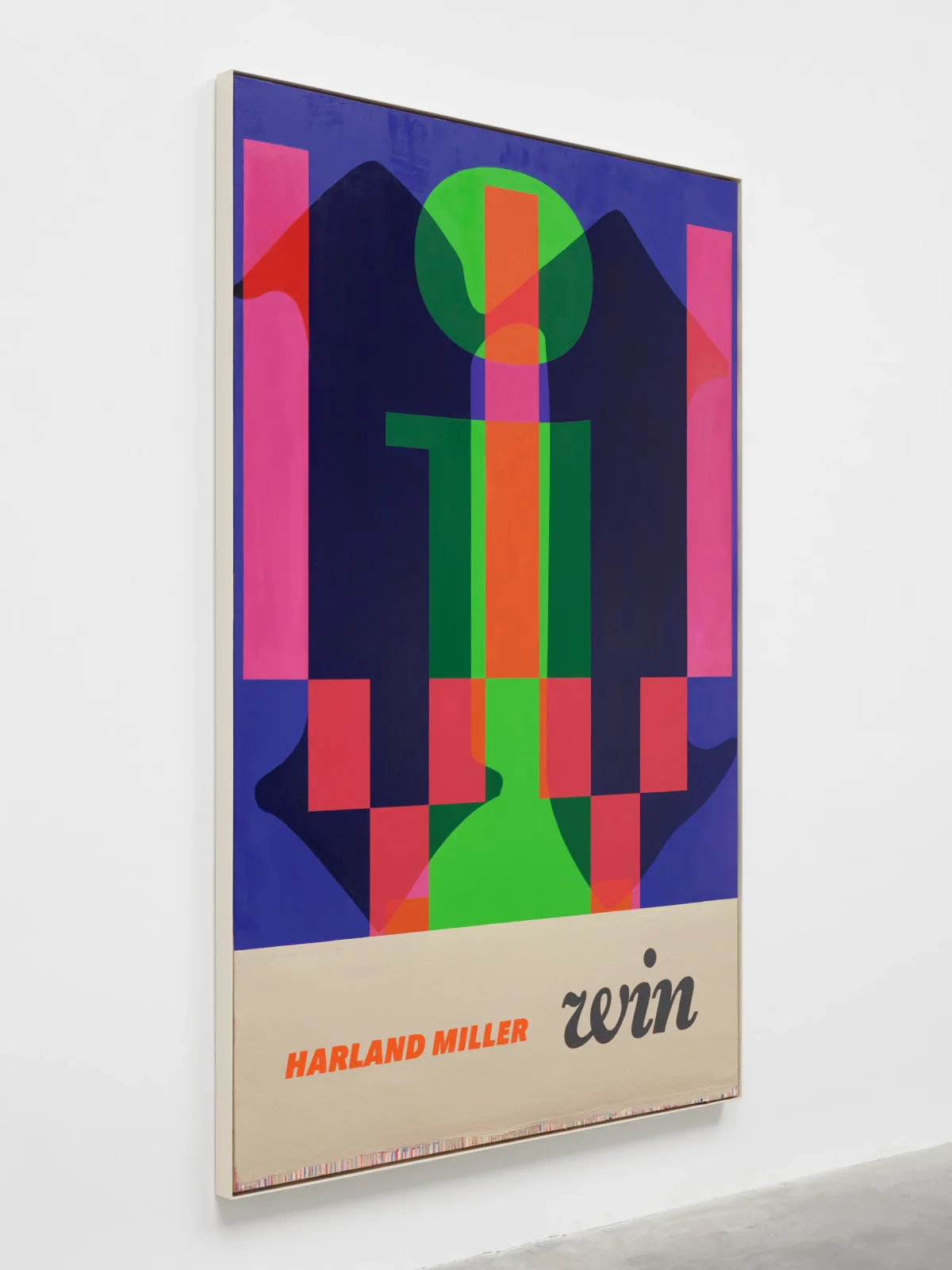
Originally created as a monumental painting in 2022, Win was subsequently selected for an official collection published by King & McGaw for Team GB in celebration of the Paris 2024 Olympic Games. The result brought one of Miller’s most direct and optimistic works into a sporting context where its message could hardly have felt more appropriate.
Who is Harland Miller?
Harland Miller is a British artist and writer recognised for combining painting with language, typography and the visual identity of printed books.
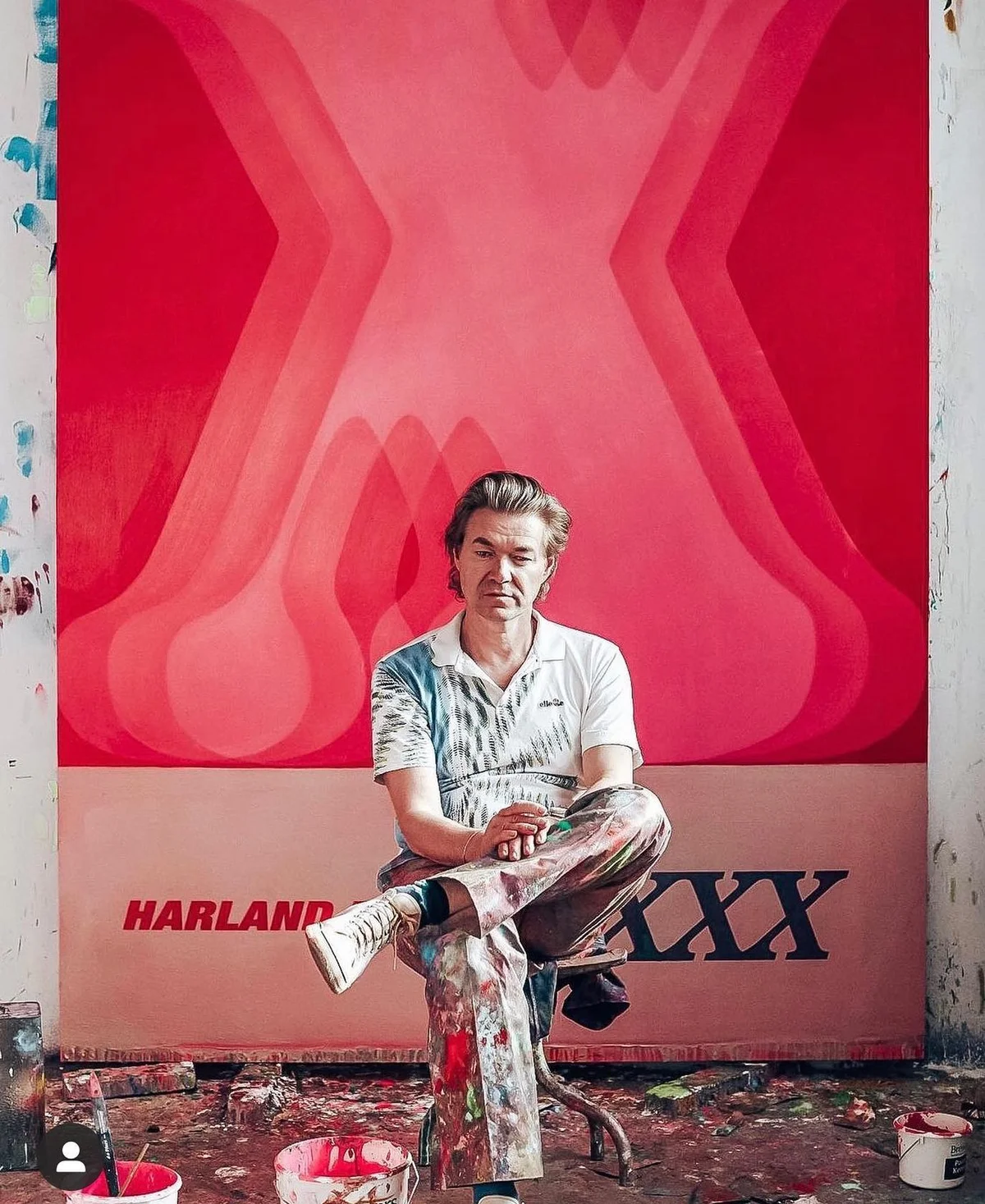
Born in Yorkshire in 1964, Miller spent periods living in New York, New Orleans, Berlin and Paris before establishing himself in London. His work draws from literature, popular culture, graphic design and the dark humour associated with his northern English upbringing.
Miller first became widely known for his paintings inspired by vintage Penguin book covers. Recreating the familiar coloured bands and typography of the classic designs, he replaced their original titles with phrases of his own: sometimes humorous, sometimes melancholic and frequently balancing both emotions at once.
These imagined titles allowed Miller to bring together his parallel interests in painting and writing. The words provide an immediate point of entry, but their meaning changes according to the colour, composition and personal experiences each viewer brings to them.
As Miller has observed, people begin reading almost automatically. His work exploits that instinct, creating a tension between encountering an image and decoding a piece of language.
The original Win painting
The story of Win began before the Paris Olympic Games.
Miller created the original work in 2022 as an oil painting measuring an imposing 264 × 182cm. It formed part of the body of work surrounding his White Cube Bermondsey exhibition, Imminent End, Rescheduled Eternally, which ran from November 2022 until January 2023.
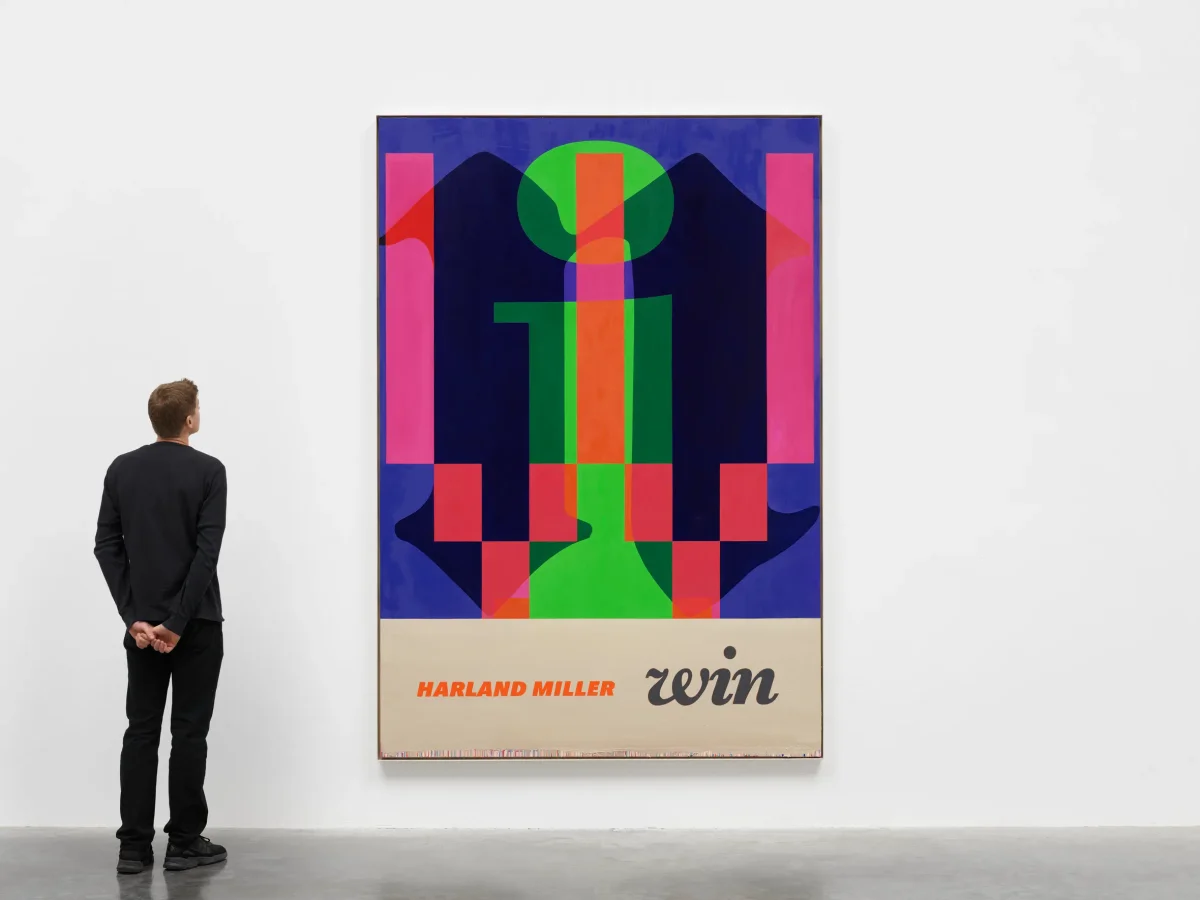
At that scale, Win is not simply a word placed on a canvas. Its letters become architectural.
Blocks of pink, red, orange, green, blue and near-black overlap to construct the three characters. Certain sections are immediately legible, while others merge into the surrounding geometry. The eye moves between reading “WIN” and experiencing the work as a piece of colourful abstraction.
The lower section retains the structure of a book cover, with Miller’s name positioned as its author and Win appearing as its title. It is a familiar arrangement within his work, but the energetic colour and enlarged typography push the composition far beyond conventional graphic design.
What are Harland Miller’s Letter Paintings?
Win belongs to Harland Miller’s celebrated Letter Paintings series.
The origins of the series can be traced to Miller studying the history of lettering at A-level. He became fascinated by illuminated medieval manuscripts, in which the opening letter of a passage would be enlarged and intricately decorated.
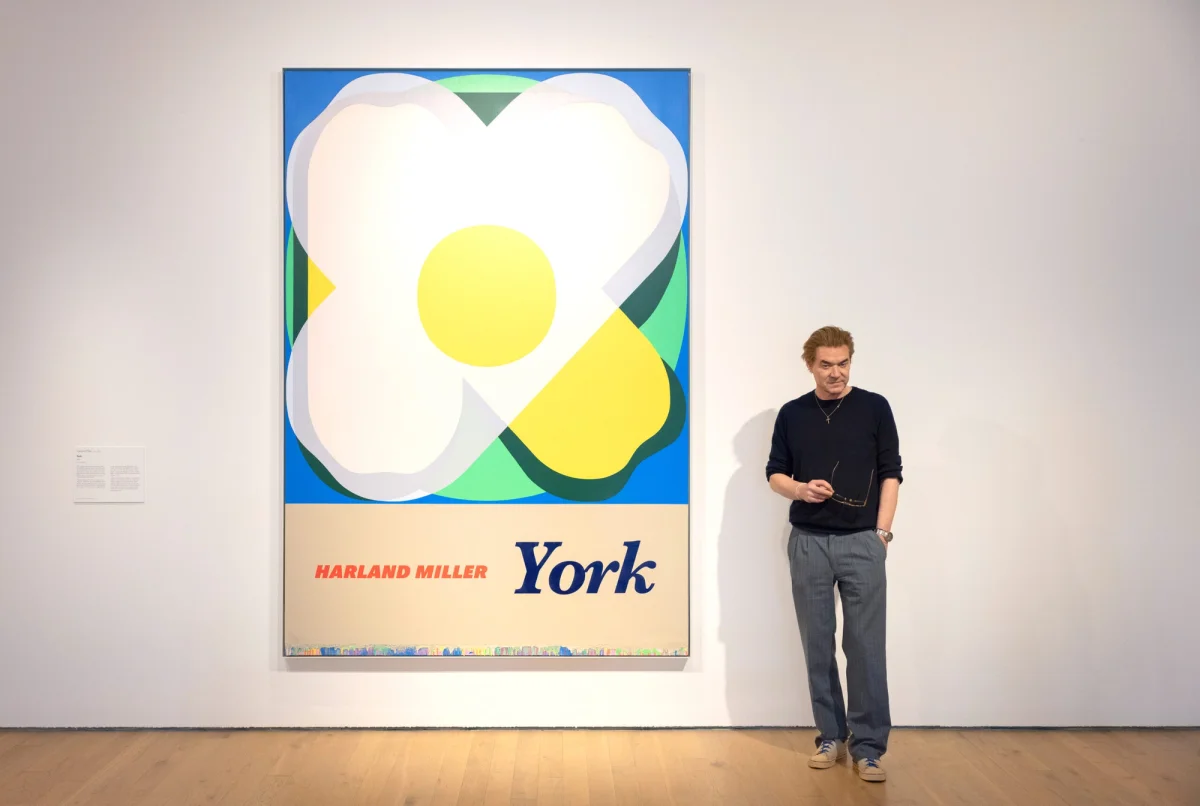
Miller approaches that historic tradition through the visual language of Pop Art. Individual letters are magnified, layered and reconstructed using bold colour and graphic forms. References to vernacular signage and artists such as Robert Rauschenberg and Ed Ruscha sit alongside the influence of illuminated manuscripts.
Unlike Miller’s earlier Penguin-inspired paintings, which are often driven by long, darkly comic titles, the Letter Paintings frequently use just one short word or acronym. Works including ACE, LUV, BOSS, XXX and WIN show how even the simplest piece of language can contain multiple visual and emotional possibilities.
The letters remain recognisable, but Miller’s process of isolating, overlaying and reconnecting their forms begins to break language apart. The viewer is encouraged to look at the shape of a word rather than only reading its meaning.
Why did Win become a Team GB artwork?
In 2024, King & McGaw brought together nine prominent artists for an official Team GB collection celebrating the Paris Olympic Games.
Alongside Harland Miller, the project included work by Julian Opie, Rose Wylie, Marc Quinn, Fiona Rae, Bella Freud, Philip Colbert, Tunji Adeniyi-Jones and Corbin Shaw. The collection explored sport, competition and national identity through a range of different artistic approaches.
While several of the contributing works directly referenced particular athletes or sporting disciplines, Miller’s contribution relied on one universally understood word.
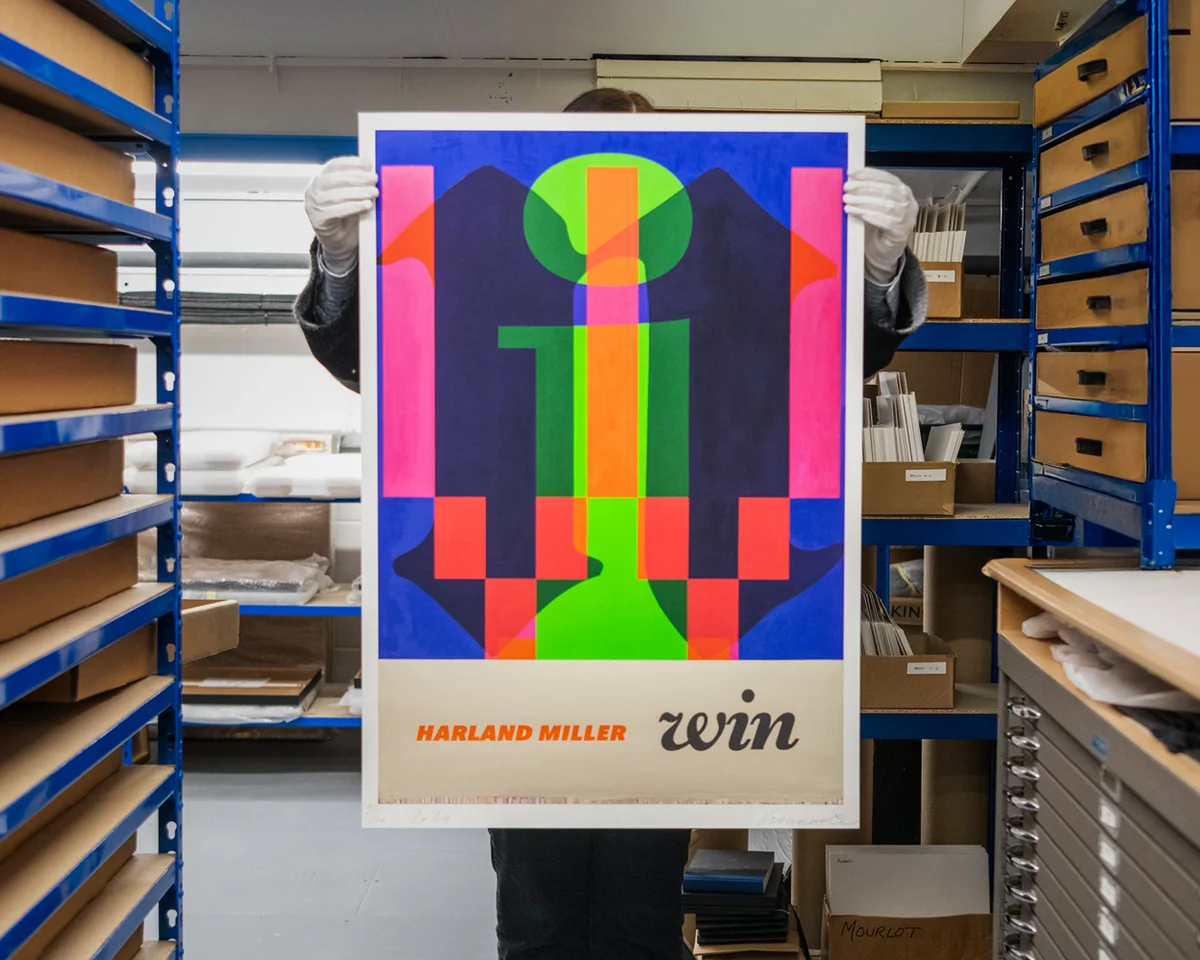
In an Olympic setting, Win becomes an immediate rallying cry. It captures the hope felt before an event, the determination required to compete and the exhilaration that follows success.
Miller has described the feeling produced by hearing the word “win” as something almost intoxicating. It is a revealing observation: the power of the work does not come from a complicated phrase, but from everything that its three letters allow us to imagine.
More than a celebration of victory
Despite its apparent positivity, Win is not necessarily as straightforward as it first appears.
Victory always contains an element of uncertainty. Before somebody can win, they must risk losing. The word can therefore evoke pressure and expectation as easily as celebration.
That tension is reflected visually. The letters are bold and commanding, yet they are also fragmented, partially obscured and absorbed by competing areas of colour. What appears to be a direct statement becomes less stable the longer we look at it.
This openness is central to Miller’s work. His words rarely arrive with one fixed interpretation. They can be public declarations, private thoughts, jokes, memories or fragments of an imagined story.
Within the context of Team GB and Paris 2024, Win speaks naturally about sporting achievement. Away from that setting, it can represent any personal success, ambition or moment of resilience.
Harland Miller’s use of colour and typography
Colour plays an essential role in how Win communicates.
Its vivid palette gives the work an immediate energy, but the colours also alter how the letters are read. Transparent and overlapping sections create the appearance of several forms moving through one another, producing a sense of depth within an otherwise flat, graphic structure.
Miller has explored how changing the colour surrounding a word can alter its emotional weight. A phrase presented in pink may carry a different tone from the same phrase in green or black. In Win, multiple colours compete within the same word, allowing confidence, excitement and tension to coexist.
The result sits somewhere between painting, typography and book design. It can be read from across a room as a graphic statement, but rewards closer attention as the construction of each letter gradually reveals itself.
From Win to XXX
Miller has continued to explore overlaid letterforms through works such as XXX.
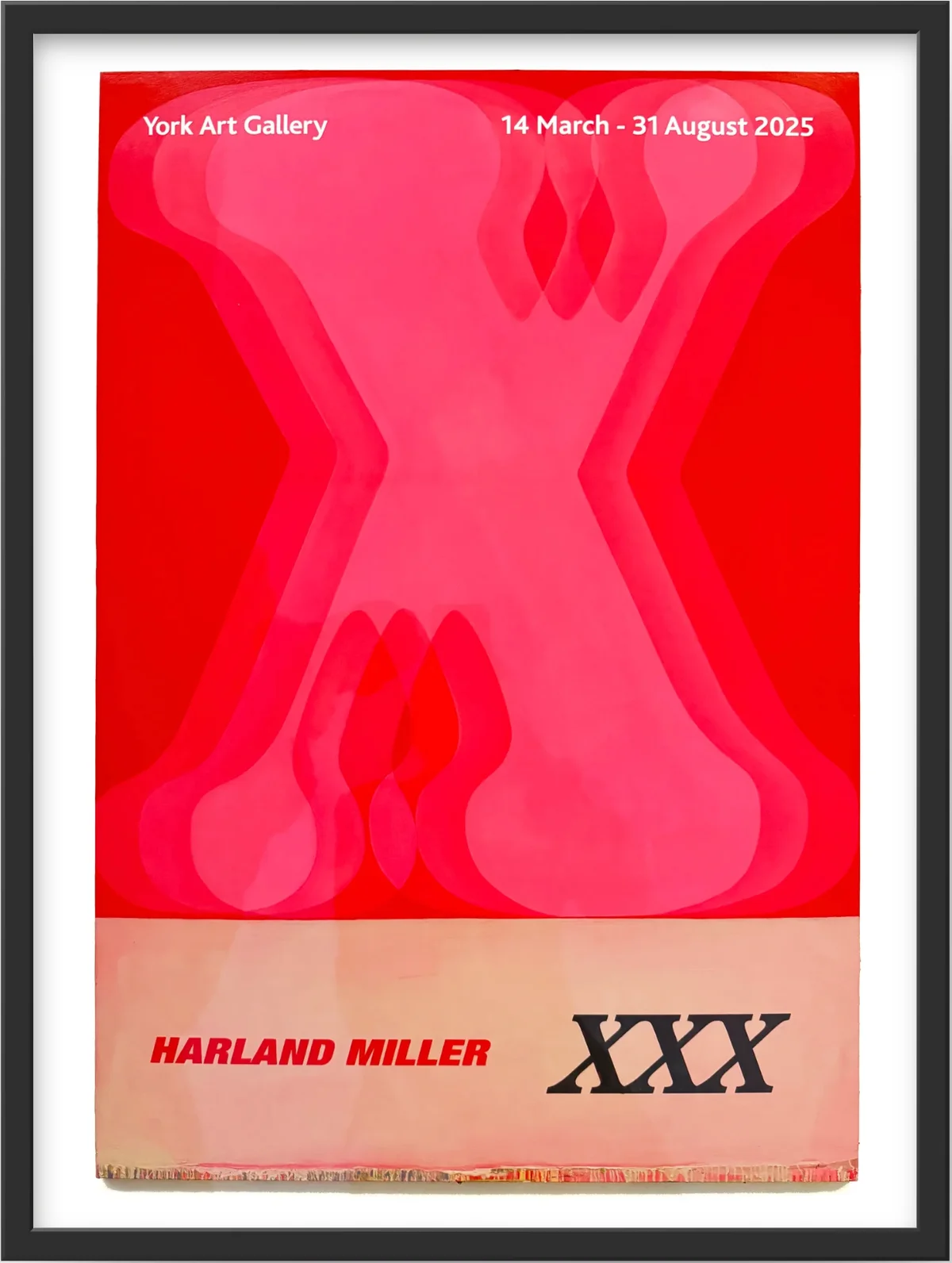
In XXX, repeated versions of the letter X appear to move through one another, creating a kaleidoscopic composition built from colour and transparency. White Cube has described the forms as appearing almost like a sequence of transparent slides compressed into one image.
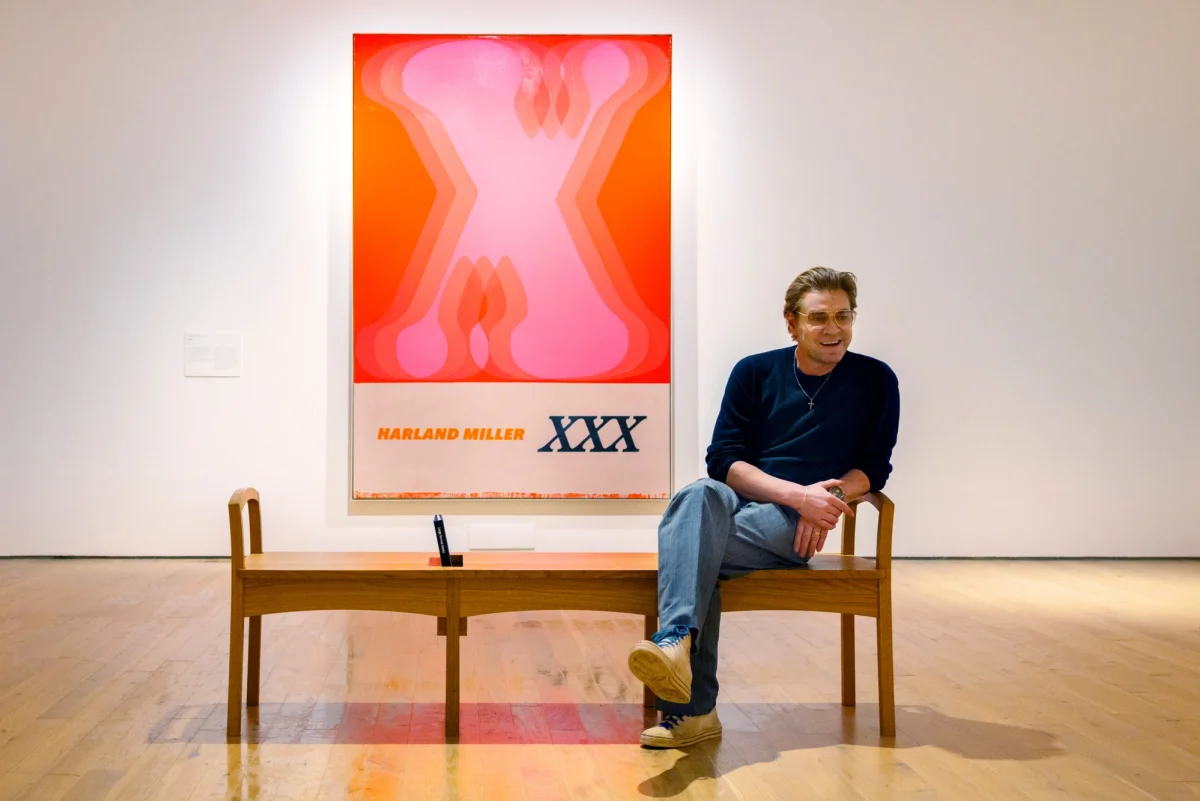
The work became the title image for Harland Miller: XXX, a major exhibition at York Art Gallery in 2025. The exhibition brought together paintings and works on paper from the Letter Paintings series and examined Miller’s continuing fascination with the narrative, visual and aural possibilities of language.
Seen together, Win and XXX demonstrate the range Miller can find within remarkably limited language. One uses a recognisable word charged with ambition and optimism; the other repeats a single letter until it becomes almost entirely abstract.
Win by Harland Miller at Electric Gallery
The version of Win now available at Electric Gallery was published by King & McGaw as part of the official Team GB collection for the Paris 2024 Olympic Games.
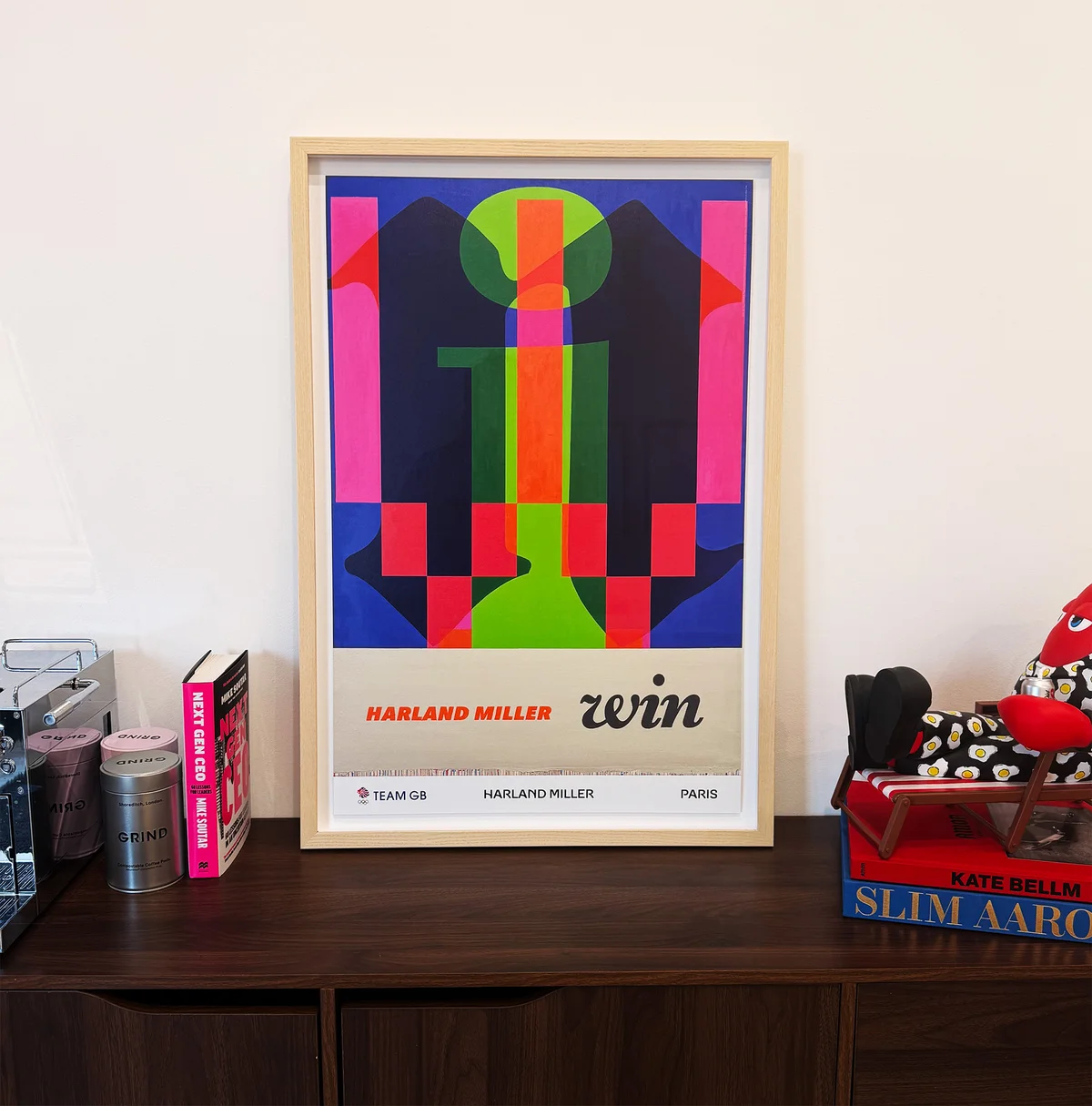
Although connected to that historic sporting moment, its appeal extends far beyond Olympic memorabilia. It is a striking example of Harland Miller’s Letter Paintings: bold, colourful and built around his enduring interest in how language can operate as both image and idea.
We currently have one available.
Discover Win by Harland Miller.
Also available is Harland Miller’s XXX, released to accompany his major 2025 exhibition at York Art Gallery and showcasing the bold colour and typography of his celebrated Letter Paintings series.
Discover XXX by Harland Miller.
Frequently asked questions about Harland Miller and Win
What is Harland Miller best known for?
Harland Miller is best known for paintings inspired by vintage Penguin book covers. He replaces the original book titles with phrases of his own, combining humour, melancholy, literature and painting. He is also recognised for his more recent Letter Paintings, including Win, XXX, ACE and LUV.
When did Harland Miller create Win?
The original Win painting was created in 2022. It is an oil on canvas measuring 264 × 182cm. King & McGaw later published the image as part of its official Team GB collection celebrating the Paris 2024 Olympic Games.
Was Win created especially for the Paris Olympics?
The original painting predates the Paris Games, having been created in 2022. The image was subsequently selected and published for the King & McGaw and Team GB collection in 2024.
Is Win part of Harland Miller’s Letter Paintings series?
Yes. Win uses the defining features of Miller’s Letter Paintings, including enlarged and overlapping letterforms, saturated colour and a book-cover-style band containing the title and artist’s name.
What does Harland Miller’s Win mean?
There is no single fixed interpretation. In its Team GB context, the word naturally represents sporting ambition and victory. More broadly, it can evoke confidence, pressure, hope, determination and personal achievement.
Where can I buy Win by Harland Miller?
Electric Gallery currently has one example of the official King & McGaw and Team GB release available here.